Simple level crossings for 3-rail layouts
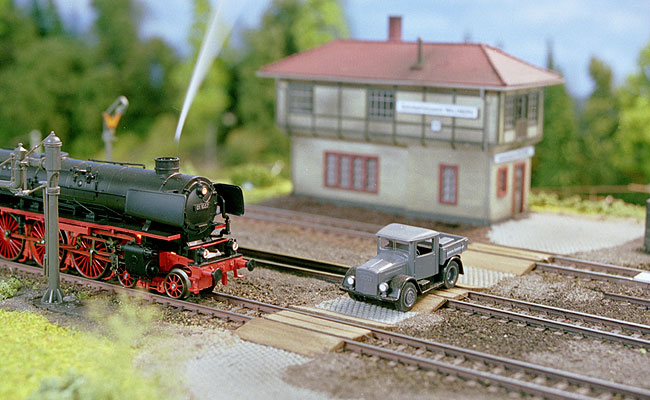
Constructing a level crossing on a Märklin layout is always a little bit more difficult than on DC layouts. The centre studs cannot be covered, since they provide power to the locomotives. While I was working on the depot I came across this typical Märklin problem.
A depot has simple level crossings. They are often made from available materials such as timber or sleepers. These materials are used to fill the space between the rails. A little slope is created on both sides of the track to raise the road to the level of the rails. Such a simple level crossing is easy to make yourself.
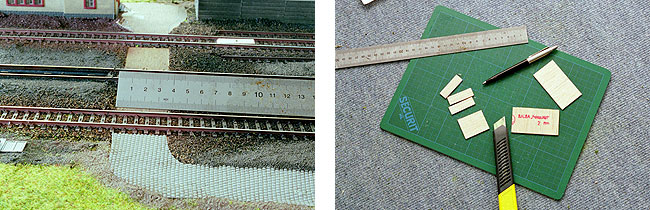
I used 2 mm Balsa for the wooden parts. I pressed the wheels of a cheap car into the soft wood to find the correct width for the centre piece. Nearly all roads in the depot are about 4.5 cm wide. I made the centre piece a little bit wider, so I could shift it around a little bit. The slopes have a similar width and length.
I sanded the slopes into the shape of a wedge to give them the correct angle. They now better fit the level of the road. Finally I engraved the Balsa with some fine lines to imitate planks. All parts were painted with brown Revell Enamel paint, which I whiped off at once. This gives a nice stained effect and the grooves come out a little darker then the planks.
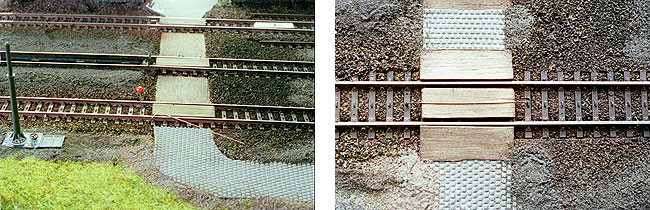
The centre piece is glued between the tracks with white glue. This covers the centre studs and a new way of getting power to the locos had to be found. I used a piece of Sommerfeldt Profi overhead wire for this. The wire is about 0.3 mm thick.
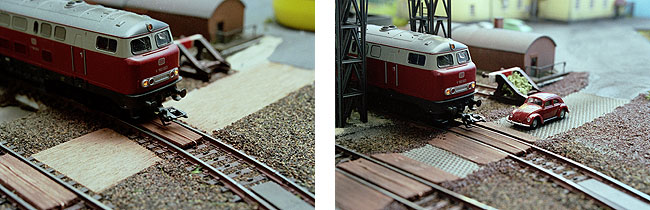
The wire is forced between the centre studs on both sides of the level crossing. This keeps the wire and the centre piece in place. The centre studs also provide power to the wire. Please take into account that inserting the wire into the sleepers is quite hard. With K-track the wire can only be inserted on one side of the centre studs.
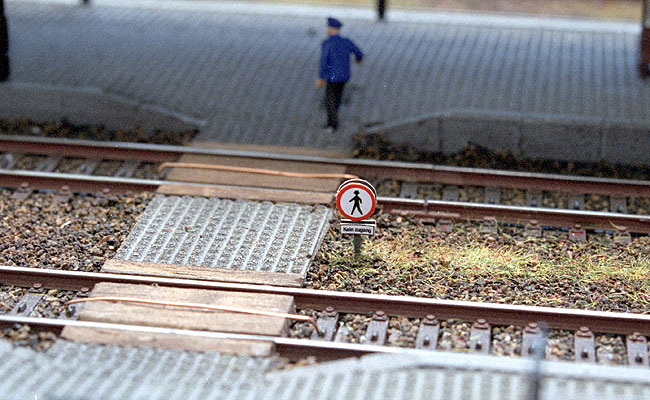
Constructing such a simple level crossing should not take more than 15 minutes. The same method can be applied to other level crossings. You do not have to use wood, but you can also use ready-made parts or plaster. Good luck!
2001